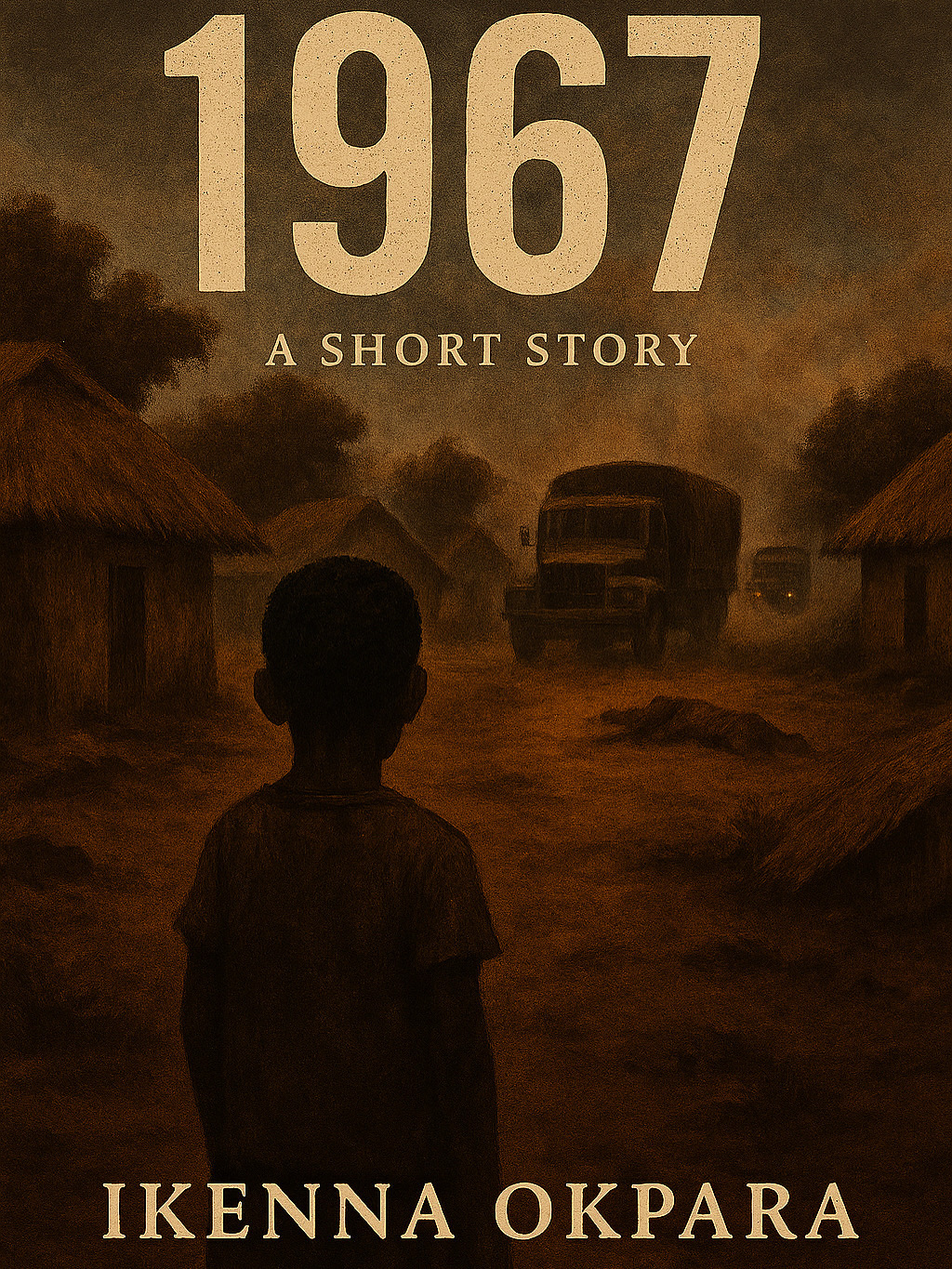
I was only eleven years old when the war broke out. Four months in, the Northern troops took Okigwe. I ran towards my hometown that day, ran until my lungs burnt.
Uru was only a few miles from Okigwe, close enough that I could hear the rumble of their waggons as I fled. I cursed myself with every step. What business did I have being out here, this far from home, at a time like this?
My legs were too small to carry me as far as I needed to go. My only option was the bushes.
I threw myself belly-flat into the scanty undergrowth and held my breath. The first waggon rattled past, angry and relentless. Then the second, just as violent. When the third began to pass, I thought I was safe. I was about to catch my breath, about to thank my chi, when I heard a voice bark something in a language I didn't understand, followed by a sharp command in English: 'Stop!'
My heart dropped to my stomach.
I began whispering prayers — words I was certain would be my last. Papa had told me the stories he heard on his small radio. Stories of how our people were not spared in nearby villages, regardless of age. These soldiers didn't care how old you were. They used their machetes until the blades ran red. Their guns screamed smoke as lives were snuffed out. I heard Papa's voice in my head as footsteps approached.
I peed in my tattered trousers, but wetting myself was the least of my problems.
My mind screamed silent pleas. I felt completely numb, unable to speak or lift my head. I could sense someone beside me — maybe more than one person — but I couldn't look.
'It's nothing,' a voice called out towards the waggon. Close. Too close. 'Must have been a squirrel or some bush animal. Engage the engine, let's move.'
Then, in a whisper meant only for me: 'Boy, as soon as this waggon leaves, get away from here as fast as you can. I can only imagine what foolishness brought you out here at a time like this.'
His voice was already fading. I looked up to catch his face, but all I saw was his broad back flexing underneath the tight camouflage uniform he wore as he jogged to the waiting waggon. As he climbed in, he turned and nodded in my direction.
I caught his face then.
He would never know how much gratitude I owed him. He seemed tough. But kind.
I could hear screams — children, women — as I approached Uru. The closer I got, the louder they became. Fear consumed me.
Uru was a small village of just over five hundred people, two-thirds of them women and children. The village square came first into view when you entered the hamlet. As I ran towards it, a scream stopped me cold — a girl's voice, agonised and raw. Then another sound, lower. Male. Like the sounds I'd heard Papa make when he and Mama were in their room at night.
I walked closer. My eyes widened.
A soldier was on top of Oluchi, Pa Okoye's youngest daughter. She was only fourteen. Oluchi was my favourite person — I'd dreamt of her every day since I was eight. She had the most beautiful eyes I'd ever seen.
What could I do? I was helpless. I couldn't save the girl of my dreams.
She continued screaming through her tears as the soldier went harder. The camouflaged man increased his pace, moaning as he continued his torment.
Tears streamed down my face as I left them both.
I would remember that agonising sound for the rest of my life.
The scent of fresh air faded, replaced by the metallic smell of blood. As I moved through the village, I overheard a couple arguing — the wife's voice thick with tears, the husband's cold and insistent. They were debating whether to throw away their newborn to avoid attracting the soldiers' attention with her crying. The mother refused to give up her baby. The father insisted it was their only chance at survival. The woman said she would rather die with her child in her arms than give her up out of fear.
I couldn't make sense of the argument. I moved away from their voices.
The sound of approaching soldiers and the cries of villagers being herded forward sent me diving into hiding again. I watched my people being commanded like slaves in their own village. From where I crouched, I could see everything clearly.
They arrived at the square — soldiers leading, villagers following.
When I spotted Papa, a soldier was pushing him towards the centre. My uncle Okafor followed behind. The two brothers were told to face each other. From where I hid, I couldn't hear the instructions, but suddenly Uncle Okafor swung a slap across Papa's face.
The soldier instructing them was angry. He slapped my uncle hard, demonstrating how to deliver a proper blow.
Okafor's second attempt left my father clutching his left eye. I flinched from my hiding place.
Then it was Papa's turn. He slapped even harder.
They went on like this for what felt like forever, both men's faces swollen and red by the end.
The women were forced to kneel and watch. The village men were lined up in a single file.
The crack of a gun made me scream inside.
Papa was amongst the men. Mama was wailing. So were the other women.
When I looked through my damp eyes, it was the man who had saved me holding the gun.
He shot the first man dead. The body crumpled. He commanded the second to step out of the line — he was free. The third man fell to the gunshot. The fourth was waved away, spared. That's when I understood the pattern — shoot one, spare one. A terrible game with the highest stakes.
My hands shook as I started counting. I had to know where Papa stood in line.
When I reached him in my count, my stomach dropped. Papa was in the wrong position.
I couldn't watch, but I couldn't look away. The soldier moved methodically down the line. Each gunshot brought him closer to my father.
I dropped my head as the shot rang out. The screaming voice was my mother's.
I wanted to run to her, to console her. But I couldn't move. Shock held me frozen.
The angry roar of their waggons' engines made me shake — fear and relief tangled together. They were finally leaving.
I didn't stop crying. Papa was dead, and I had done absolutely nothing.
As they hit the road, my soldier hero caught my wet eyes. He nodded — solidarity, maybe — as the third waggon drove off.
The soldier who had saved me had killed my father.