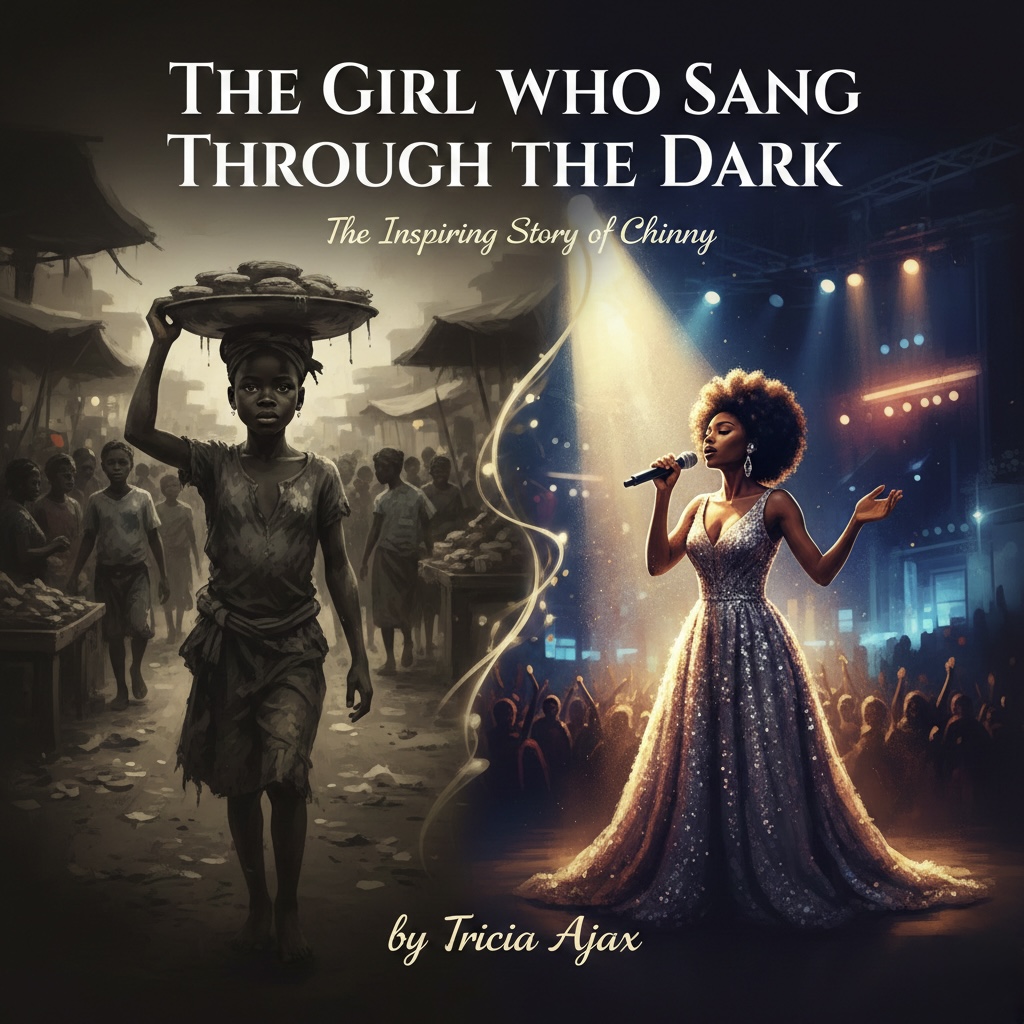
Before Chinny ever opened her eyes to this world, grief had already found her family. Her father died when her mother was seven months pregnant — gone before he could hold his last child, before he could whisper her name. And when Chinny was just two years old, her mother followed him, leaving behind four small children who were too young to understand death, yet old enough to feel the terrible weight of its silence.
Chinny. The baby. The last one.
She had two big brothers and an elder sister, and for a brief, fragile moment, they had each other. But grief, when it is deep enough, has a way of pulling families apart before it pulls them together. Her mother's family stepped in, and what looked like a rescue turned out to be something far more painful: separation. Each child was taken to a different home. One went here, another went there, and little Chinny was handed to her mother's elder sister, a woman married with six children of her own.
In that house, Chinny did not know she was different. How could she? She called the woman 'Mummy'. She called her husband 'Daddy'. She laughed with the other children, ate at the same table, and slept under the same roof. She was a child, and children believe what love tells them, and for a while, love told her she belonged.
But as the years passed and Chinny grew, something shifted. The warmth she once felt began to thin like morning fog burning off under a harsh sun. Whilst her cousins were dressed for the best private schools — schools with libraries and laboratories and teachers who knew each child's name — Chinny was enrolled in a public school where the roof leaked and the desks wobbled. Whilst the other children sat in classrooms, Chinny was at the market or on the farm, her small hands doing the work of someone twice her age, racing against the sun just to make it to school before the day was halfway gone.
She noticed. Of course she noticed. Children always notice more than adults think they do.
'Why is my surname different?' she would ask herself in the quiet moments, early mornings before the house woke, or late nights when exhaustion held her still but sleep refused to come. The question lived in her like a splinter she could not reach. Why was she always the one assigned the hardest chores? Why did nobody ask how she was doing?
One day, summoning more courage than a girl her age should ever have to find, Chinny asked her 'parents' the question that had been hollowing her out from the inside.
The answer broke something in her that would take years to mend.
'You're not our child.'
Four words. She can still hear them today — the exact tone, the exact cadence, the echo of them bouncing off the walls of that house she had called home. Four words, and suddenly the whole architecture of her life collapsed into rubble. She was not the youngest daughter. She was not a daughter at all. She was an orphan who had been too young to know she was one.
What followed was a kind of slow drowning — starvation some nights, maltreatment and neglect that left marks not just on the body but on the spirit. Chinny endured it all, held together by something she could not yet name. And then one day, when the weight became unbearable, she did what she had to do.
She packed her bags, walked out the door, and didn't look back.
The cruellest part, the part that still stings when she speaks of it, was not the cold nights that followed, or the hunger, or the uncertainty of not knowing where she would sleep. The cruellest part was the silence from the house she had left. Nobody came looking. Nobody called. Nobody worried. She had lived amongst them for years, called them family, and when she disappeared, the world they lived in simply closed over the space she had occupied, like water over a stone.
But Chinny was still standing. Barely — but standing.
She took to the streets of Enugu State, hawking whatever she could, sleeping wherever night found her. The streets are not kind to young girls who have no one, and Chinny knew every shade of that unkindness. She was alone in the way that only the truly abandoned understand, a loneliness so complete it feels like its own kind of weather.
Yet in the middle of all that darkness, there was music.
There had always been music.
On the nights she went to bed hungry, even when there had been food in the house she'd been kept from, Chinny would cry, and then she would sing. It started as a way to survive the feelings, to give her pain somewhere to go. Her voice rose in the dark, soft and aching and impossibly beautiful, and it filled the empty spaces that loneliness had carved inside her. People would stop what they were doing just to listen. Strangers. Passersby. They couldn't always explain why, only that something in her voice reached through the noise of everyday life and touched a part of them they had forgotten was there.
She sang whilst she hawked. It was just what she did, walking the streets with her goods balanced on her head, her voice trailing behind her like something sacred.
Then one ordinary day, on an ordinary street in Enugu, a stranger heard her.
They didn't buy her goods. They pulled out a phone and pressed record.
Within hours, the video was everywhere. The lone street hawker with the voice that stopped traffic. The girl who sang like she had nothing to lose — because she didn't. Chinny was viral. Comments poured in from Lagos, Abuja, London, New York. People wanted to know: who is this girl? Where did she come from? How does someone that young sound like that?
Amongst those who saw the video was King Lexon, a music producer with a reputation for finding talent before the world knew it existed. He didn't just listen to the clip once and move on. He watched it again and again. Then he started looking for her.
He found her.
What happened next was not magic — it was work, discipline, investment, and belief. King Lexon trained her, guided her, and gave her something she had not had since before she could remember: a home. He took her in as his own daughter, not as a house help, not as a dependent, but as family — real family, the kind built on intention and love and showing up.
And Chinny? She rose.
From the dusty streets of Enugu State to stages her younger self could never have dreamt of, Chinny became a name people said with reverence. Her voice, which had once been her only shelter on cold, hungry nights, became the very thing that carried her into the hearts of millions around the world.
She didn't become a star despite everything she survived. She became a star because of it, because suffering had deepened her, because loneliness had given her something true to sing about, because every night she cried herself to sleep, she chose, in the morning, to get up and keep going.
There is a girl in Enugu right now — perhaps in Lagos, perhaps in London — who is lying awake in the dark, wondering if things will ever get better. Wondering if she matters. Wondering if the world has any room for her.
Chinny's story is the answer.
She was that girl. And look at her now.